
Identity Is Electromagnetic
Neil Theise on interstitium, heart fields, deathbed visions, and the bliss of “not remembering”

Some episodes of Entangled Health feel like conversations.
This one felt like walking into a field - and only later realizing the field was walking into us. (Does that make sense?).
We were not sure if the meeting was to discuss the podcast or DO the podcast, so we started recording midway - this time not Zencastr but Teams, but hey, audio and video should be OK - check it out and let me know (please) …
It was not OK (broken for the intro - Thanks Resolve, you drive me crazy) - it is now fixed.
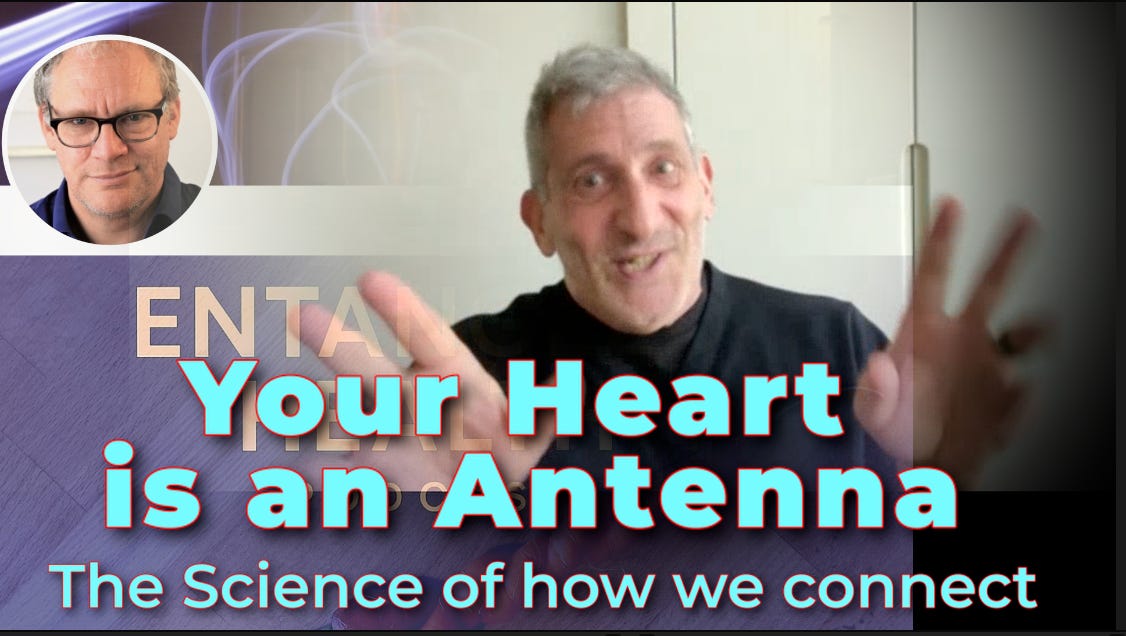
Image Credit: The Thumbnail which was proposed to get a million clicks on youtube - let’s see if that works.
With Dr. Neil Theise, we started with liver pathology and a “new” organ, and ended up with heart fields, shamanic initiations, Gödel’s incompleteness theorem, and his mother dying in what he calls a “bliss bubble.” Along the way we hit expat alienation, tattoos, Portuguese rivers, and why he once accidentally became a hero to the U.S. anti‑abortion lobby.
And somehow, it all fit.
Because underneath every tangent was one unifying claim:
Identity is electromagnetic.
1. The expat who forgot who he was
The conversation doesn’t begin in the lab. It begins in Lisbon.
Neil did what many of us idly fantasize about doing and almost no one actually does: he retired from a successful medical career in New York and moved with his husband to Portugal. New city, new language, new life.
And then came the shock.
He thought it would be like earlier reinventions: moving to London in his youth for liver pathology training, or his sabbatical at Yale. New place, yes, but still anchored by familiar faces. There were always cousins, friends, colleagues, people who knew the story so far.
Lisbon was different. Lisbon was a blank.
“It was surprisingly difficult moving here, more than I expected. And I look back and I think I’m kind of an idiot.”
On paper, he had every reason to be fine. He had his husband, a beautiful apartment “a block and a half from the water,” and a lifetime of achievements. He’d even come off antidepressants because he was excited about retiring and moving to Europe.
A month in, he found himself thinking:
“What the hell was I thinking?”
The problem wasn’t the food, or the bureaucracy, or the hills. It was ontological.
No one knew who he was.
The handyman who came to help around the house eventually Googled him and said, with some surprise:
“You’re a doctor. You’ve written a book. That’s not who I thought you were.”
Who did he think Neil was?
“Well, with all the exercising you do and all the tattoos, I thought you were a gangster.”
Another local thought he might be a Marine.
Not one guessed: “world‑class liver pathologist, complexity theorist, Zen Buddhist, shamanic practitioner, interstitium co‑discoverer.”
It was funny. And it was deeply disorienting.
Neil realized how much of his sense of self had been woven out of tiny reflections from other people: nods in hospital corridors, “Hey, Doc”s from colleagues, students who knew him as “the complexity guy,” patients who knew him as the one reading their biopsies.
“That constant subtle or not subtle reaffirmation of: I’m this person who spends his time in this way, is known by this many people for these things… affirms who I think I am. And it was very disorienting to me to come here and have no external affirmation other than my husband, who’s trying hard to deal with the fact that I’ve retired and now I’m suddenly in his face all the time.”
So he rented an office. For his husband’s sanity.
But also, implicitly, for his own.
Because if identity is relational — if “who I am” is partly the sum of how other nervous systems respond to me — then uprooting your social network is not just moving. It is an identity amputation.
We usually frame that as psychology: culture shock, retirement depression, loss of status. Neil takes it a step further. He wonders if there is a cellular recognition happening underneath the social layer.
The body, not just the biography, is disoriented.
2. The new organ hiding in plain sight
Before Lisbon, before heart fields, there was the interstitium.
If you saw the headlines a few years back about “a new organ discovered in the human body,” that was Neil and colleagues. They weren’t looking for it. They stumbled on it by doing something oddly radical in 21st‑century medicine: looking at living tissue instead of dead slides.
Under the microscope, they saw not a solid layer of connective tissue, but a shimmering “sponge” of collagen and elastin bundles with fluid‑filled spaces in between — a continuous, body‑wide network. It showed up beneath the skin, around blood vessels, lining the gut and lungs. Rich in protein‑laden fluid, draining into the lymphatic system, absorbing shock, potentially offering highways for cancer cells to spread.
“What we saw is this layer of the bile duct is this open fluid‑filled space supported by this collagen bundle latticework… This fixation artifact of collapse has made a fluid‑filled tissue type throughout the body appear solid in biopsy slides for decades, and our results correct for this to expand the anatomy of most tissues.”
Call it an organ, call it a “tissue type,” call it a scandal in slide preparation. Either way, it forces a shift.
We are not sacks of organs floating in empty space. We are lattices, a continuous, dynamic mesh of fluid, collagen, cells, and fields.
If you were writing a science‑fiction metaphor for “ether,” “morphic field,” “matrix,” this would be a good place to start.
And this is exactly the kind of thing complexity theory, Neil’s other main obsession, loves. Complexity asks: how do simple local interactions (collagen fibers, fluid pockets, pressure changes) scale up into emergent phenomena (shock absorption, disease spread, maybe even… consciousness)?
As Neil likes to put it elsewhere:
“Complexity theory can foster an invaluable flexibility of perspectives and awaken us to our true, deep intimacy with the larger whole, so that we might return to what we once had: our birthright of being one with all.”
Which is beautiful. But also, in Lisbon, not immediately comforting.
Because being “one with all” feels different when the “all” no longer recognizes you.
3. Identity as recognition (and as field)
One of the most useful parts of our conversation, to me, was painfully simple.
We become ourselves through recognition.
Not just mirror‑recognition (“I know that face”) but response‑recognition: How many people nod when I walk down this corridor? Who asks for my help? Who lights up when I enter a room? Who seems bored?
Neil noticed that even the most trivial hallway nod, two people who don’t know each other’s names, just “you again, existing”, contributes to a coherent sense of “me.”
Take all of that away, and something strange happens. The mirrors go dark. You keep projecting, but nothing comes back. You can “reinvent” yourself — new tattoos, new gym routine, new language — but it’s like broadcasting into a void.
Now layer on his other claim:
“On very subtle levels, we are who we are because of how the world and other living beings connect back to us. And I don’t think any of these are separate concepts. I think they’re all just different facets of the same.”
Social recognition and electromagnetic recognition are, for him, different expressions of the same entanglement.
Which brings us to Mark, his husband, and one of the sweetest research instruments in the episode.
4. Your heart is an antenna
Neil has had strokes, a shoulder repair, a hip replacement — the full middle‑aged medical bingo card. Recovery was slow. Fatigue was real. For the first time, he had long stretches with “nowhere to go in the morning.”
So he began paying attention.
He goes to bed two or three hours before Mark. Usually he falls asleep quickly. But on nights when he can’t:
“When he comes to bed, I fall asleep. And I like to refer to him as my sleeping pill.”
Cute. But then he adds detail that turns “aww” into “hmm”:
“There’s this idea that hearts, living beating hearts, entrain to an electromagnetic field, the pulsing of an electromagnetic field, if the heart is placed in that field.
But hearts are also electromagnetic - they generate their own fields. And apparently are so exquisitely sensitive to each other, that two living hearts being brought into proximity within feet are already starting to entrain to each other.”
In the biofield literature, the heart’s electromagnetic field is often described as the strongest in the body, measurable several centimeters to even a meter away with sensitive equipment. Studies of “cardiac physiological synchrony” in couples and co‑sleepers show heart rate variability (HRV) aligning during shared contact or emotional engagement.
Neil doesn’t need the equipment. He has mornings.
He wakes up, gets out of bed, feels something missing. Now that he’s retired, he often goes back for a “morning nap”, or more accurately, a morning re‑entrainment:
“I can feel the reunification of this field connection he and I have. I can move in and out and feel the intensity changing depending on my distance from him… It has physical parameters. It’s not just an idea.”
When long‑term couples die within weeks or months of each other, some clinicians chalk it up to grief, immune compromise, stress. In Japan, there’s even a medical term for something like “broken‑heart death.” Neil is willing to entertain a further layer:
Your heart doesn’t just miss the person. It misses the field it’s been co‑regulating with for years.
Viewed that way, “identity is electromagnetic” is not a metaphor. It is a literal description of a system of oscillators (hearts, brains, cells, interstitium, environment) in dynamic coherence and decoherence.
No wonder losing your office, colleagues, city, country, and language is destabilizing. All your entrained patterns are suddenly asked to improvise.
Which brings us to the other big pattern‑breaker in Neil’s story: his mother.
5. “When you live in the now, you’re happy”
Neil’s mother was, by his own description, a highly anxious woman for most of his life.
So anxious that as a child he invented a backstory for her: during the Blitz, a bomb had fallen on her head, which explained why she was “a little bit off.” (For the record, this did not actually happen. The fact that 10‑year‑old Neil felt the need to retrofit his mother’s neurology with World War II artillery tells you something about the intensity of her nervous system.)
Then, late in life, something very strange happened.
She lost her short‑term memory. Not in a diffuse, global dementia way, but as a “pinpoint” deficit. She knew who everyone was. Her long‑term memory was intact. But she couldn’t remember five minutes ago.
She also, Neil notes, began to seem as if “she’d been smoking pot her whole life”, relaxed, a little loopy, and for the first time, genuinely happy.
He noticed something else:
“You’re even smiling when you’re sleeping now. How do you stay so happy?”
Her answer is the kind of line that would be banned from spiritual Instagram for being too on‑the‑nose:
“Well, I no longer worry about the future, and I can’t remember the past. So all I have is the now. And when you live in the now, you’re happy.”
This is either the most efficient Zen teaching ever delivered, or proof that the universe has a sense of humor, or both.
Over the next six years, she stopped leaving her apartment. She lost her mobility, then regained it. She entered home hospice, was expected to die within months, then proceeded not to die - yet. Instead she began talking to dead relatives. Then to dead people she hadn’t known in life, but who seemed to find her a good medium.
Then came out‑of‑body experiences. Spontaneous enlightenment experiences. A field of peace around her so strong that people walking into her apartment years later would say they could “feel” her, even after she died and the apartment had a new owner.
Neil calls it a “bliss bubble.”
From a palliative care perspective, none of this is especially rare. Longitudinal hospice studies suggest that about 88% of patients report at least one end‑of‑life dream or vision (ELDV) involving deceased loved ones, often experienced as real and comforting. Systematic reviews find that about 50–60% of conscious hospice patients report such experiences at any given time. They often reduce fear of death and help patients integrate their life stories.
From a reductionist perspective, you can hypothesize neurochemical changes, REM intrusion, hypoxia, or “comforting hallucinations.”
Neil is not satisfied with stopping there.
He sees his mother’s journey as data — not in the sense of “proof” of afterlife, but in the sense of an existential experiment in what happens when a lifetime of anxiety is interrupted by the forced Zen of radical present‑moment living.
She became a different person. Or perhaps more accurately, different layers of her came into coherence.
And her apartment became, in his words, a “place of refuge.” People felt it as soon as they crossed the threshold, long after she died. The new owner, a practitioner and teacher of Chinese medicine, walked in and thought:
“I felt your mother.”
She later lit a memorial candle on the anniversary of her father’s death and heard a voice say, in precisely the tone Neil recognized:
“Good girl. You’re good.”
If identity is electromagnetic, maybe some part of that field stays. If complexity theory is right, maybe patterns of relationship don’t vanish when one node disappears; they echo in the network.
If nothing else, it’s hard to argue with a bliss bubble.
6. Sacred spaces, rivers, and stuffed animals
One of my favorite mini‑threads in this conversation is how casually Neil and I both talk about places having “vibes” and how seriously he is willing to consider that.
He lives near the Tejo river in Lisbon. It’s not a small, picturesque brook, it’s an estuary, “vast,” like the rivers he lived near in New York. A big part of his adjustment was simply biking along the water and sitting at the shore.
“I can feel everything be okay while I’m there.”
He used to attribute this to being able to see the horizon and the sky. Then, when I brought up magnetic orientation and the way I sometimes have to rotate the bed in a hotel room to sleep, he paused.
Maybe there’s more going on.
Maybe rivers are part of the biofield environment. Maybe Schumann resonances, geomagnetic fields, soundscapes, smellscapes, and the subtle architecture of a room all tune our nervous systems in ways we can feel but can’t yet model.
He and Mark have a long history of creating homes that people don’t want to leave.
Before they met, each had their own spaces where friends would linger long past the socially acceptable exit time. Together, this capacity seems to have gone exponential. Wherever they go, they build what guests experience as an unusually safe, comfortable, “special” home.
Neil is frankly puzzled:
“I can’t say how it is that we did that… There definitely feels to be something more than just ‘we know how to design a space well.’”
I offered my own lifelong habit of animating stuffed animals with personality as a maybe‑too‑on‑the‑nose analogy: perhaps we’re constantly imprinting our fields on objects and spaces. He didn’t dismiss it. He folded it into his growing sense that there is a multi‑sensory, multi‑field sacredness to some places — and a corresponding darkness to others.
He describes visiting Tuol Sleng, the former school turned torture prison in Cambodia under the Khmer Rouge:
“I stepped over the threshold… it felt like the temperature dropped and something awful.”
His cousin, a tough Dutch pig farmer, felt it even more strongly. They had similar experiences visiting sites connected to his family’s murder in the Holocaust.
You can construct psycho‑historical explanations. You can say the mind knows the context and generates the feeling. But as Neil says:
“The fact that we can’t necessarily in a clear way by contemporary Western scientific standards explain them doesn’t mean that they don’t exist. It just points to the incompleteness of our theories.”
Sacredness, on this view, is not a metaphor. It is a real property of systems: homes, rivers, torture prisons, gardens with a grandmother’s bench, emerging from how matter, history, and attention entangle over time.
7. Shamanic initiation and the engine of intuition
At this point you might reasonably ask: how does a conservative profession like pathology feel about one of its own talking this way?
The answer is: complicated.
Neil didn’t start as the guy who talks to shamans and gives Zen talks. He started as someone who felt he “wasn’t a particularly good scientist” because he didn’t spontaneously generate hypotheses in the lab.
Then, sometime in his 30s, something shifted.
“My brain just opened up and became this engine of hypothesis‑making and insight.”
The timing coincides with more than a decade of Zen practice. Long before shamans, before rivers in Portugal, there was sitting on cushions in New York, watching his mind wander off to grocery lists and then, occasionally, to genuinely new scientific ideas.
He describes two kinds of thinking:
The ordinary “let’s design an experiment and see what happens” thinking, where any outcome would be interesting but not surprising.
The intuitive certainties, where he simply knows what an answer will be before the experiment and then runs the experiment anyway because, well, that’s what you do.
“I can show you my publication list. I can show you which ideas came to me that way. And if you look at the number of publications on each topic as reflective of the importance of it, those ideas are what built my career.”
Zen, he thinks, “opened him up” to this channel. Shamanic practice, which he insists came “out of left field” and was not something he was seeking, refined it.
His shamanic teacher’s main message?
“Pay attention to one’s intuitions and honor them. Just because there isn’t an intellectual explanation for why you feel something does not invalidate it. And if you pay attention to it, things reveal themselves.”
This is where Gödel enters the room.
In his book Notes on Complexity, Neil spends a whole chapter on Gödel’s incompleteness theorems, the proof that in any sufficiently rich formal system (like arithmetic, or physics), there are true statements that cannot be proven within that system.
In our conversation, he puts it less delicately:
Gödel is “a big fuck you to contemporary Western reductive science” which says, “If we have the right theory, we will explain everything.”
If there are always truths that cannot be proven inside the system, and yet we can know them to be true, then there must be some faculty other than formal deduction operating.
You can call it intuition. You can call it noesis. You can call it “the view from outside the system.”
Whatever you call it, Neil has decided to take it seriously, not as an excuse to believe whatever you want, but as a partner to empirical science.
The path is not “science or spirituality.” It is science, complexity, Zen, shamanism, devotional candle‑lighting, and soup kitchens, all seen as parallel, mutually reinforcing contemplative practices.
“I don’t think there’s anyone who couldn’t benefit from some sort of meditative practice, but I don’t think it’s the only way… People can have great insights into the nature of reality simply by showing up and doing good work in a soup kitchen feeding people.”
8. Deathbed visions and the end of fear
We’ve already met Neil’s mother’s visions. She’s not alone.
Christopher Kerr’s longitudinal hospice study found that 88.1% of patients in a small inpatient sample reported at least one dream or vision involving deceased relatives or friends. More recent work and reviews suggest that roughly 50–60% of conscious hospice patients report end‑of‑life dreams and visions at any given time, often experienced as real, meaningful, and comforting.
These experiences often help patients resolve unfinished business, find forgiveness, or simply feel accompanied as they die.
Neil is fascinated by these phenomena, not because he thinks they “prove” anything about an afterlife (he’s careful not to overclaim) but because they do something observable: they seem to generate growth and meaning even in the face of physical deterioration.
Patients who are, in every medical sense, dying, are also, in an existential sense, developing. Their last months become, paradoxically, a stage of profound psychological and spiritual maturation.
Complexity theory has a lot to say about systems that reorganize under stress. Zen has a lot to say about dropping fear at the edge of the cliff. Shamanism has a lot to say about crossing between worlds.
Neil’s life happens to sit at the intersection of all three.
Watching his mother die in her bliss bubble, he doesn’t see denial. He sees someone who, after a lifetime of anxiety, has finally become perfectly present — by a combination of neurological accident, devotional practice, and perhaps grace.
The boundary between her and “the field” thinned. People walked into her apartment and, years later, still felt her. The candle was lit. The voice said, “Good girl. You’re good.”
If identity is electromagnetic, maybe death is not the switching off of a bulb, but the rearrangement of a field.
9. So what do we do with this?
If you’ve made it this far, you may be feeling one of three things:
A) Relief: “Finally, someone with serious scientific credentials is allowed to talk about this stuff without being dismissed as a crackpot.”
B) Skepticism: “Okay, nice stories, but where are the controlled trials of bliss bubbles?”
C) Something like both at once. Can you say superposition?
Neil might say you’re having a complex experience, which is the only kind worth having.
Here’s what I take from our entangled conversation:
Identity is relational at every scale.
Socially, we become who we are through how others respond to us. Biologically, our hearts entrain to each other’s fields. Systemically, our cells, organs, and interstitium are nested in larger networks of interaction. There is no autonomous self, only degrees of coupling.Fields matter.
Homes, rivers, torture prisons, hospital rooms, benches in a grandmother’s garden … all carry imprints. Whether you explain that in terms of EM fields, acoustics, memory, or morphic resonance, the pragmatic advice is the same: curate your fields. Make your home a sanctuary. Go to the river. Light the candle.Intuition is not optional.
Gödel doesn’t give you license to believe anything, but he does prove that any formal system is incomplete. Something outside the system is required to see the system’s limits. In practice, that “something” often feels like intuition. Zen, shamanism, devotional practice, and simple service are all ways of tuning it.Bliss is a skill, not a glitch.
Neil’s mother didn’t “accidentally” become happy. Her short‑term memory loss, long‑term devotional practice, and the field of attention around her all converged on a state where she literally couldn’t hold on to fear. She became, unintentionally, a very committed non‑dual meditator.
“I no longer worry about the future, and I can’t remember the past. So all I have is the now. And when you live in the now, you’re happy.”
Science is bigger than scientism.
When a liver pathologist who has helped redefine human anatomy tells you that shamanic initiation improved his science, it’s worth listening. Not because “shamans are scientists,” but because reality is one system, and different disciplines are just different ways of listening to it.
Neil’s work in complexity theory starts with ants, stem cells, and fluid‑filled tissue planes. It ends (for now) with this kind of sentence:
“Who am I becomes a question of: from which scale am I looking at myself?”
From the scale of a retired expat in Lisbon who suddenly feels like no one.
From the scale of two hearts oscillating in the same bed.
From the scale of an interstitium that quietly links everything.
From the scale of a mother in a bliss bubble, talking to dead relatives and forgetting why she ever worried.
Identity is electromagnetic. And also social. And also narrative. And also sacred.
Complexity theory doesn’t tell us which of these is “correct.” It tells us that they are all complementary views of the same underlying murmuration.
The invitation, then, is not to choose between them, but to learn to shift perspectives — to sit on the cushion, light the candle, do the biopsy, visit the river, listen to the dreams of the dying, and notice how each vantage point reveals a different facet of the same entangled health.
And if along the way someone mistakes you for a gangster because you got a few extra tattoos, take it as a sign you’re doing the experiment right.
Enjoy the audio or video
Follow Neil: https://www.neiltheiseofficial.com/