
What Quantum Computing Actually Does For Drug Discovery - Entangled Health podcast w/ Gopal Karemore (IBM)
IBM's quantum lead reveals why 90% of clinical trials still fail, what AlphaFold can't solve, and how two hours beat years
Those of you who are with me since longer here might recall that I planned to publish these articles “soon” after the recording is done and the episode release, I’m working on the back log. Time is relative (Albert Einstein).
I’ve known Gopal Karemore for a good while now. He once was a peer in our Healthcare Industry (back then at Novo Nordisk) - and then switched over to the other side, namely IBM as Quantum Computing provider. Over the years, our conversations have evolved from cautious optimism to raw honesty about what quantum computing can and cannot do for medicine.
We’ve written together articles for Science Books, debated at conferences, and shared many late-night coffee chats (or rather Chinese Bowls), many of which flirted with skepticism, exuberance, and sometimes outright frustration. But what I love about Gopal besides his deep expertise is his capacity to cut through noise. He doesn’t hype what’s not ready. Instead, he shares what’s real, what’s emerging now, and what still needs work.
Recently (actually 29 Oct 2025), we sat down for a podcast that I’m excited to bring into this space, because it’s not just about the technology, it’s about how quantum, biology, and medicine are entangled. Of course, the Entangled Health podcast - what else…
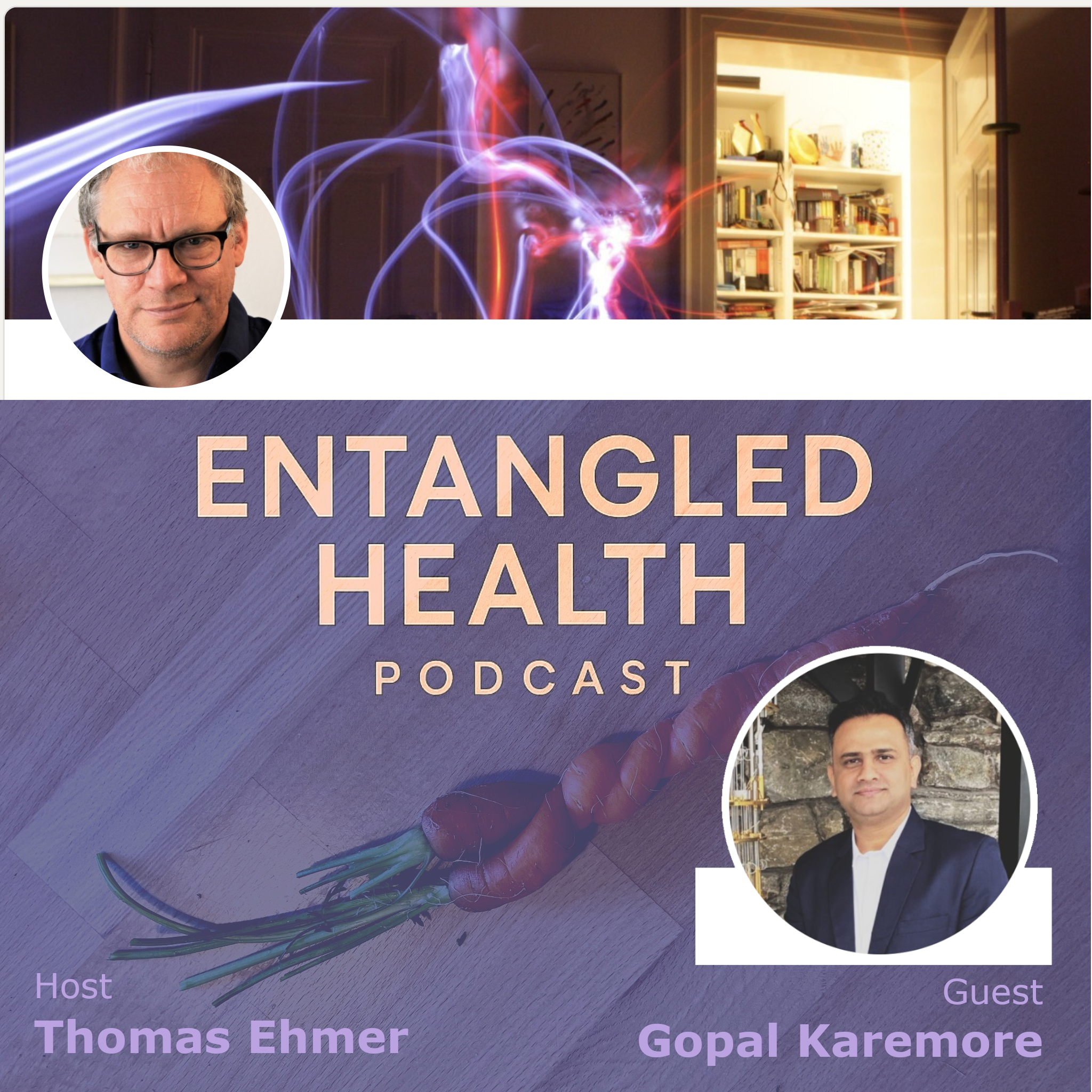
Again, this post is my attempt to capture that experience as a “sitting down with …” reflection on the podcast interview. Field notes and an invitation to join me in wondering about the future. (and yes - an invitation to subscribe here and to the podcast and join the discussion)
The Unexpected Revolution: Why Healthcare is Quantum
Gopal’s opening line is blunt but crucial:
“When you reached out about this podcast, the title really resonated, Healthcare is understanding biology. Biology is driven by chemistry. Chemistry is governed by physics. And if you want to understand mechanistic medicine at the atomic level, that’s where quantum physics lives.”
Too often, discussions about AI or classical supercomputers ignore the fundamental nature of molecules and their interactions. Yet, the hardest problems, like protein folding, drug interactions, and metabolic pathways are inherently quantum. Gopal emphasizes that “we’ve only scratched the surface.” Despite breakthroughs like AlphaFold, which made many think the problem was solved, he underscores that AlphaFold actually works best when there’s a lot of data and clear analogs.
But biology isn’t just about known proteins; it’s about disordered proteins, mutations, allosteric sites, and transition metals. Areas where data isn’t enough, and physics becomes unavoidable. This is where quantum simulation shines. It allows us to model molecules at the electron level, something classical computers struggle with.
From Small Town to Quantum Labs
I’ve known Gopal for a while, and his story surprises many. Born in a tiny town called Tumsar in India, he was an “average student”—a phrase he ribbingly still uses. He loved physics and biology, and those passions drove him into electronics engineering, then into medical software, then academia and pharma.
He spent years at Novo Nordisk, pushing the boundaries of protein research and cutting-edge biophysics—with a focus on how molecules behave at the quantum level. His move to IBM was natural. Now, at the legendary Yorktown Heights lab, he leads efforts to make quantum computing practical for health. What I really like about Gopal is his humility—his recognition that fundamentals always matter.
“Tools are useful, but without basic science—pipetting, assays, biological validation—we’re just building castles on sand.”
The Real Power of Quantum: Solving Problems in Hours, Not Years
Here’s what I keep coming back to: IBM, in collaboration with RIKEN in Japan, solved a problem in two hours that would otherwise take years. The problem? Simulating iron-sulfur clusters, molecules with complex electron interactions—key elements in metabolism, enzyme function, and drug mechanisms. Classical supercomputers just can’t handle the multi-referential quantum states involved. The solution? Sample-based quantum diagonalization—a hybrid approach that uses quantum machines to identify the most relevant configurations, then classical supercomputers to finish the calculations.
Gopal’s eyes light up as he describes this (you can’t see it because the podcast is audio only, but you can hear the eyes lighting up literally - in itself an interesting fact):
“Quantum doesn’t replace classical—it’s a new kind of co-pilot. It helps us focus our computational resources where they matter most.”
This is a critical insight. Overhyped claims of “quantum supremacy” often miss the point: the goal isn’t to replace classical computing but to augment and accelerate it.
Why AlphaFold’s Nobel Doesn’t End the Story
When AlphaFold won the Nobel in 2024, many assumed the hard problems of protein folding had been solved. Gopal’s take? It’s a huge achievement, but not the end of the story.
“AlphaFold is brilliant for proteins with lots of data,” he says. “But what about proteins that don’t fold neatly? Intrinsically disordered proteins, mutations that alter structures, allosteric sites that are distant from where a drug binds?”
These represent the majority of drug targets and biological complexity. He emphasizes: “Physics-based quantum simulations are still needed here.”
Quantum Walks: Exploring Knowledge Graphs Faster
If you’re into graph theory or complex network analysis, Gopal’s explanation of quantum walks becomes fascinating.
“Imagine a knowledge graph that maps genes to proteins to pathways to diseases,” he says. “Classically, exploring this graph takes time, you have to follow one node at a time. Quantum walks can explore all paths simultaneously, finding hidden connections much faster.”
The Clinical Trial Fiasco and How Quantum Optimization Can Help
Here’s a sobering statistic: 90% of drugs fail in clinical trials. Mostly because trial designs are off—not necessarily because the science is flawed but because of poor planning. Gopal sees quantum as the tool to optimize trial frameworks—patient cohorts, treatment combinations, dosing—all through complex combinatorial optimization algorithms like QAOA and VQE.
“We’re not controlling trials,” he says. “We’re designing better trials—more efficient, more predictive.”
The Road to 2029 and Beyond
When I pressed him about timelines, Gopal was clear:
“2025 is about scale. 2026, the first time we’ll genuinely see quantum advantage. By 2029, we’ll have 200 logical qubits, enough to simulate molecules nobody else can. That’s when the game really changes.”
But he’s quick to remind: hardware isn’t everything.
The Critical Question: Funding Fundamental Science
Near the end, I asked Gopal what keeps him awake at night. His answer?
“How do we balance tool innovation with funding for basic science?” He’s worried that billions go into tools without enough support for chemistry, physics, and biology, fields that generate the data and understanding necessary for quantum tools to be meaningful.
“Fund the fundamentals, or we’re building castles on quicksand.”
“Learn the tools, but respect the science,” he says. “Stay curious. Stay focused. And remember: the hardest problems in health are quantum problems.”
If you have not yet done so, read more how I use IBM Quantum for my podcast here in a maybe unexpected way (user perspective, no promotion, I am using it on the “free” tier), or if you want to have a view how quantum is relevant at a fundamental level please have a look at the other episodes / articles from the series, e.g. these:
Keeper Sharkey. The Quantum Nucleus: Why (non-quantum) Chemistry Is “Wrong” About the Brain - and more
Gabriela Cimpan (Quantinuum) - Quantum Chemistry, GenQAI and the Human Element
Clarice D.Aiello - The Quantum Biology Revolution
just to name a few. Link to the Podcast / videos inside the articles.
The Quantum-Selected Question
One of my favorite parts of many Entangled Health episodes is the live quantum moment — a question pool, a real quantum circuit running on IBM hardware, and a result no one knows in advance. Did I mention this article already?
Here in this episode the quantum dice landed on question 170. Eight qubits. One Hadamard gate per qubit. Ran in 9.3 seconds on IBM Brisbane. (A side note, I have meanwhile updated my algo and it’s faster, i.e. I avoid the queue)
The question:
“Is there a piece of technology from history you’d love to bring back into modern life?” (submitted by Monica from Mexico City)
Gopal didn’t hesitate:
The Solvay Conference spirit. Not a gadget or a machine. Let’s bring back a culture.
He was in Belgium recently and had his picture taken on those famous stairs, exactly the ones where Einstein, Bohr, Curie, Pauli and a generation of Nobel laureates stood together, genuinely trying to solve one shared mystery. The EPR paradox didn’t end careers, instead it started conversations. There was a kind of structured, generous scientific combat that we’ve largely lost.
“That healthy debate,” Gopal said. “You don’t see it much in science anymore.”
I think about this a lot. We live in an era of extraordinary tools and extraordinary noise. The curiosity is still there, but buried under incentive structures, publication pressure, competitive secrecy.
What if the most important technology we could bring back wasn’t quantum at all?
What if it was just a room, smart people, one hard question - and a lot of (quality) time.
Final Takeaway
If there’s one thing I’d want you to take from this episode, it’s not a technical concept or a roadmap milestone. Gopal spent two decades crossing from preclinical assays to software to quantum. When the hardware actually became viable, he didn’t need a translator. He already spoke both pharma and physics.
Quantum computing in medicine isn’t hype, it’s happening now. IBM’s collaborations with RIKEN, Cleveland Clinic, and pharma partners prove that real breakthroughs are just around the corner. Gopal isn’t selling a silver bullet. Instead, he’s emphasizing a pragmatic, science-driven approach: focused on solving the problems nobody else can.
IBM will never be a pharma company. The hardware is coming. The algorithms are being built.
What the ecosystem needs now are the problem-owners, the people who know what questions to ask. Maybe that’s you.
A small note: I was recently also publishing stuff for advanced (non-classical) computing - e.g. this one
Some references for the IBM Quantum article
Our joint Book article:
The Quantum Computing Paradigm by Thomas Ehmer, Gopal Karemore, Hans Melo in Wiley, Computational Drug Discovery: Methods and Applications, https://doi.org/10.1002/9783527840748.ch26
Some Resources:
IBM Quantum Learning https://quantum.cloud.ibm.com/learning/en
Modeling realistic chemistry with quantum computingHow IBM, Cleveland Clinic, and RIKEN are exploring chemistry research with quantum-centric supercomputers https://www.ibm.com/quantum/case-studies/modeling-realistic-chemistry
Case study: Moderna and IBM use quantum computing to model mRNA structure https://www.ibm.com/quantum/blog/moderna-case-study
IBM Certified Quantum Computation using Qiskit v2.X Developer https://www.ibm.com/training/certification/ibm-certified-quantum-computation-using-qiskit-v2x-developer-associate-C9008400